
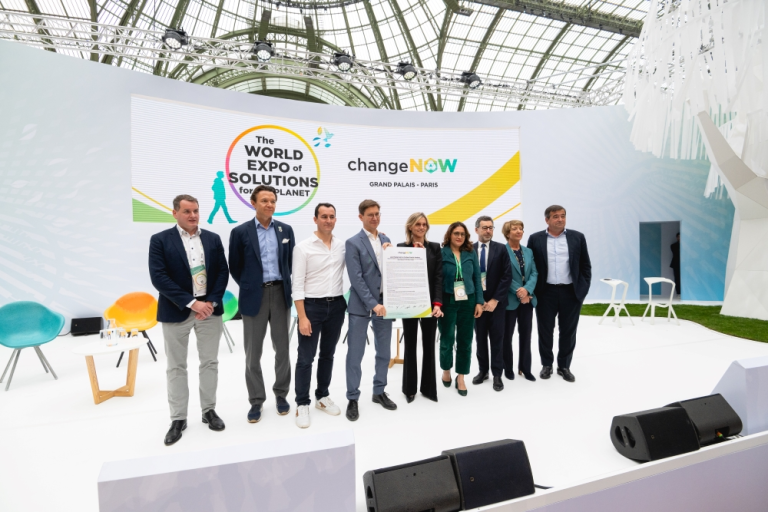
- France’s new charter sets global standards for transparent and credible carbon credit usage aligned with the Paris Agreement’s Article 6.4.
- Companies must prioritize actual emissions reductions first, using carbon credits only as a complement to a validated Net Zero strategy.
- Major global players like Schneider Electric and Capgemini have signed on, signaling strong corporate support for high-integrity climate action.
France has launched the Charter for Paris-Aligned and High-Integrity Use of Carbon Credits, setting a new global benchmark for responsible corporate carbon credit use and aiming to foster a more transparent and credible international carbon market.
Announced by French Minister of Ecological Transition, Biodiversity, Forests, the Sea and Fisheries, Agnès Pannier-Runacher, the charter builds momentum from the COP29 climate conference, where international consensus was reached on standards for validating and issuing high-quality carbon credits under Article 6.4 of the Paris Agreement.
France’s charter calls the adoption of Article 6.4 a “new beginning for carbon markets,” emphasizing that it “establishes a global benchmark that seeks to ensure the highest integrity carbon credits, and a framework that provides reference for Paris Aligned Crediting in terms of governance, methodologies, transparency, and risk prevention for all carbon credit markets.“
It also highlights that the Article 6.4 mechanism systematically contributes funding toward adaptation measures benefiting vulnerable developing nations and small island developing states (SIDS).
Two Core Corporate Commitments: The Charter demands two key commitments:
- Decarbonization First: Companies must prioritize emissions reductions through a globally validated Net Zero pathway, using carbon credits only to complement — not replace — decarbonization efforts. Independent verification, comprehensive reporting across all three emissions scopes, and time-bound transition plans are required.
- High-Integrity Carbon Credits Only: Organizations must use carbon credits aligned with Article 6.4 standards and those approved under the Integrity Council for the Voluntary Carbon Market (ICVCM) Core Carbon Principles.
Seventeen companies, including Schneider Electric, Capgemini, Beko, and FDJ United, have already signed the pledge.
“Faced with the climate emergency, international cooperation is more essential than ever,” said Pannier-Runacher. “Businesses have a key role to play: by financing high-impact projects in developing countries, they contribute to the construction of a credible, inclusive, and economically efficient carbon market, complementing their own decarbonization efforts. I reiterate my call to them: get involved!”

Corporate Backing: Schneider Electric’s Perspective At the ChangeNOW Summit in Paris, Schneider Electric executives expressed strong support for the initiative. Vanessa Miler-Fels, VP Climate and Environment, and Mathilde Mignot, Group Director – Nature & Technology-Based Solutions, EcoAct, underlined the urgent need for immediate climate action alongside internal decarbonization.
“The climate math is clear,” said Schneider Electric. “Atmospheric carbon dioxide levels now exceed 420 parts per million and continue to rise daily. Action on all fronts — reduction, avoidance, and removal — is essential. 2050 is tomorrow.“
They emphasized that carbon credits should not be seen as a substitute for operational transformation, but rather as a tool to accelerate and expand climate action. “Carbon credits enable us to neutralize residual emissions with high-quality carbon removal while contributing to action beyond our value chain,” the executives noted.
Schneider Electric highlighted that high-integrity carbon projects must meet strict principles such as additionality, permanence, leakage prevention, double-counting prevention, and independent verification — while also delivering social, environmental, and economic benefits. Projects like EcoAct’s Mangrove Restoration Project in India, which planted over one million mangroves and created sustainable jobs for local women, were cited as prime examples.